
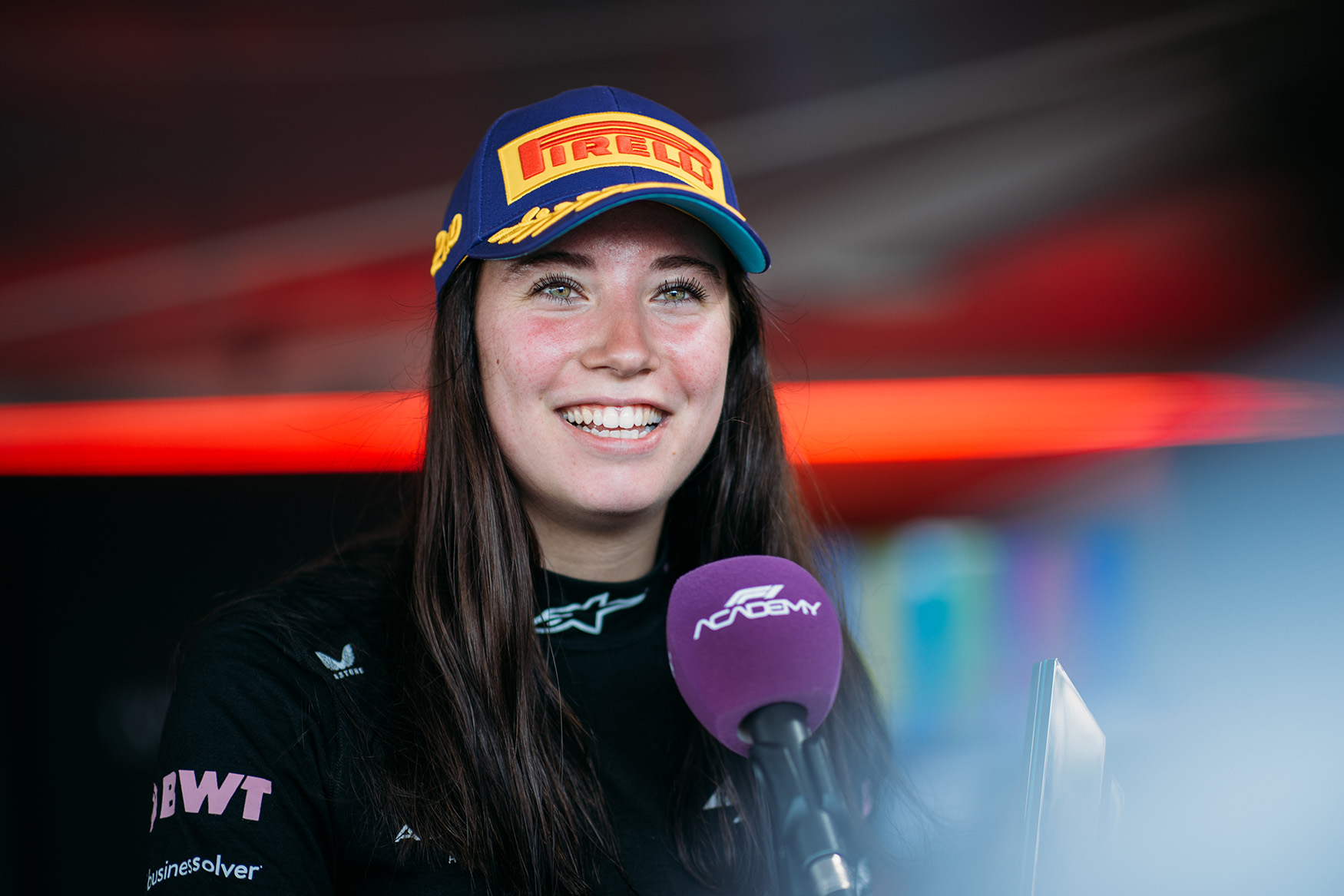
Following a long and winding career path, Nina Gademan is finally on the right track towards the goal she has set herself: FIA Formula 3. It’s all made possible thanks to her prominent presence on the F1 Academy grid. She is now in her second season, having switched to MP Motorsport, a team that operates all over the world, but with a team boss who is just as Dutch as she is. Her home race at Zandvoort is coming up soon – the circuit where we witnessed her international breakthrough two years ago. We caught up with the Alpine junior during Jack’s Casino Racing Day at Assen.
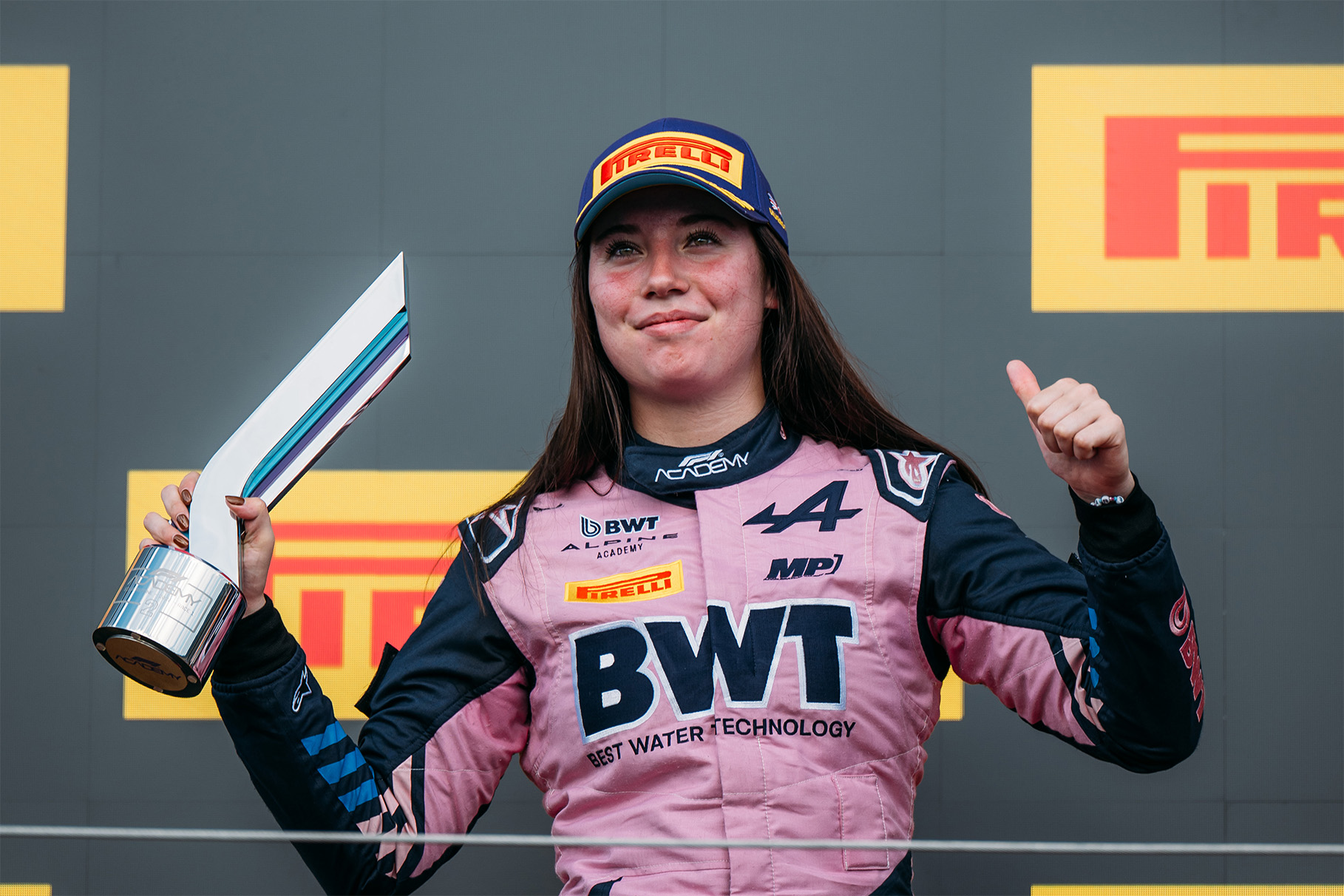
Nina Gademan is at Assen for a series of autograph sessions at one of the Netherlands’ biggest motorsport events. Her team-mate Esmee Kosterman is also in attendance, as are the pair’s F1 Academy cars. In front of the main stage in the paddock, fans are queuing up in droves, waiting for their turn at the meet-and-greet with the many Dutch racing stars on call – from Jan Lammers and Tom Coronel to Nina Gademan’s fellow MP driver Rocco Coronel and former MP drivers Richard Verschoor and Jarno Opmeer. Between two busy sessions, we speak to Gademan in the quiet of the MP trailer in the paddock. To begin with, we ask her to look back on those early days, the moment when she first caught the racing bug.
That bug was caught very early indeed, she explains, because she was still a baby when her parents took her to the local karting track in Emmen, very close to Assen in the north of the Netherlands. “They shared a kart in which they would do a few laps, and then back home. Just for fun, no racing, although my dad did take part in a few races. I’ve still got video footage of the times I was crawling around that kart as a one-year-old. So it was literally in my blood from the very start, I wanted to go karting even before I could properly speak. When I turned five, my parents finally thought I was old enough. I was given my mum’s helmet to wear – there’s a video of that too. My dad had tied a rope to the back of the kart, otherwise, I’d have gone off at full throttle! ‘No, Nina, first learn to accelerate and brake, and then drive round those two cones.’ I can’t remember much else from my childhood, but I know that I really, really enjoyed karting.”
It soon became clear that little Nina had what it takes, so the first club races were around the corner very soon. “Those went really well, so we moved on to the Dutch National Championships – in an old kart, because we couldn’t afford a new one. My dad was my mechanic. Even so, I could always keep up in the old thing. From about the age of 12, it started to occur to me how much fun it would be to make this my career. But then again, if your family can’t even afford to buy a new kart, you’re not going to get very far. Thanks to a sponsor, I was able to take part in a World Championship event once; that was pretty much the highlight of my karting career. That’s often how it goes for girls in karting.”
Gademan then took her first steps in motor racing, but there too, budget was the main constraint. “I raced in the Citroën C1 Cup for two years,” she explains. “It was the only thing we could afford. My dad was very handy with cars, so he once again acted as my mechanic. That saved us having to hire a mechanic. In the C1s, I was soon up there with the frontrunners, until I finished second in the championship. Call it a bit of an ego thing, but once you’ve achieved that, you’re not going to do another year. Moving up a level wasn’t an option, because finding sponsors at that level was simply impossible.”
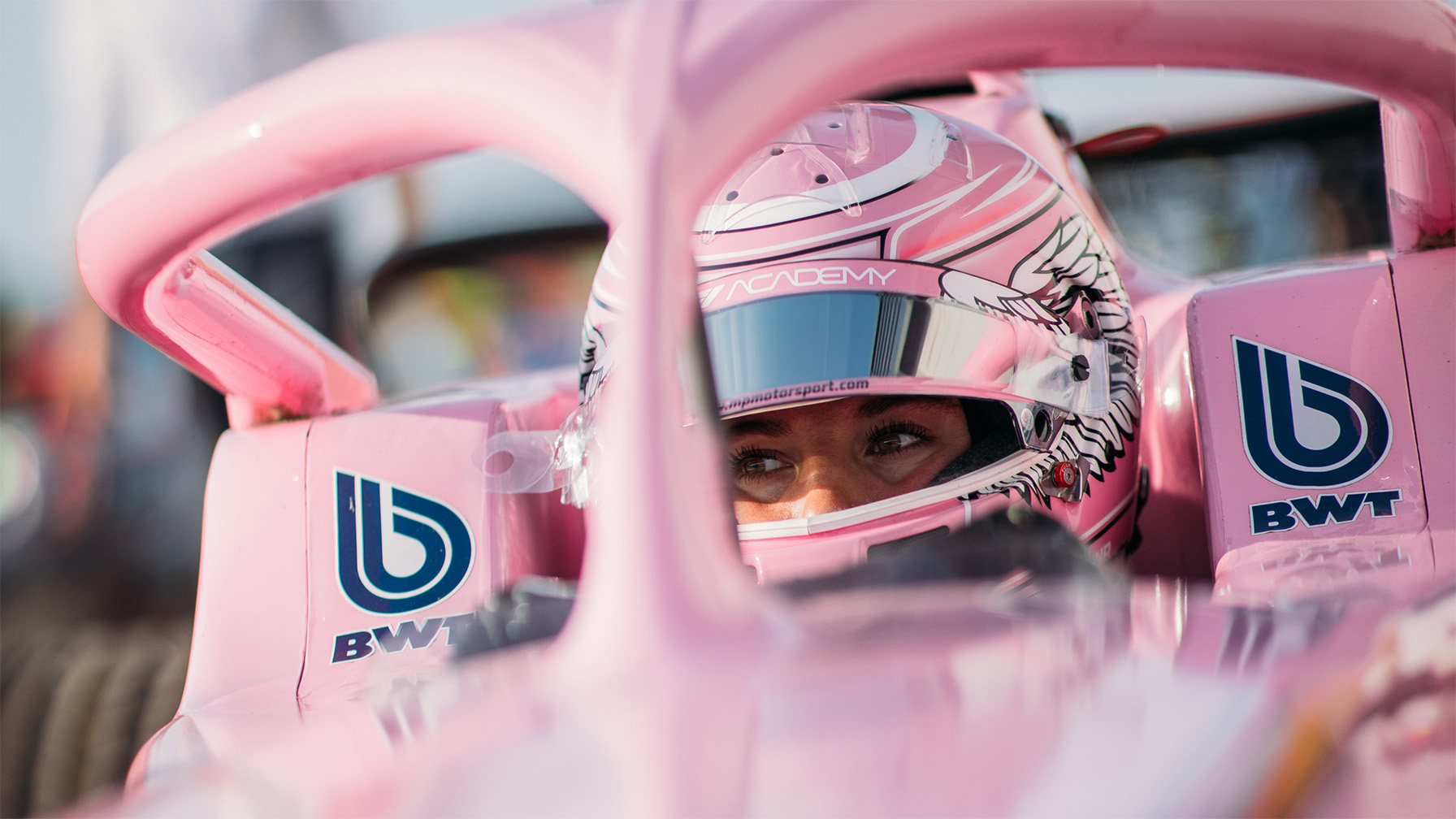
To make matters worse, her parents got divorced. “That meant all the remaining money went down the drain as well! The only reason I was able to race during those years was having three part-time jobs alongside my studies. In my final year at school, I hardly had to go to school at all, so I just worked and worked. I took on evening shifts as well, just to keep going. And then I’d spend weeks on end saving, saving, saving money, because for an 18-year-old the hourly wages are not that fantastic. Once every three months, I’d empty my savings to enter a race. Thanks to Cor Euser, who really gave me a break. We raced together in the local Dutch endurance championship, and we won a race together – one of those winter races at Zandvoort – which was brilliant fun.”
That was also the moment when F1 Academy first appeared onto the scene for Gademan. Together with Euser, she looked into what it would take to qualify for the new single-seater series promoting young female racing talent. During the period, Euser was mentoring several other young Dutch talents, such as Sacha van ’t Pad Bosch, who at the time was starting out in Spanish Formula 4, and Rik Koen, who has now found a berth in the ELMS. “But I was an inexperienced driver who didn’t have the money. It didn’t work out.”
Gademan admits she was at a dead end, but she wasn’t about to give up. “I missed karting, I missed racing. I missed everything. That’s when I started using social media. In the years before, I’d thought a few times: shall I give it a go? If I have loads of followers, maybe I can offer something in return to sponsors. So that’s what I started doing – as a sim racer on YouTube and Instagram and as a content creator for F1 esports. It took off so massively that within six months I had 300,000 Instagram followers. That’s how I got to know my management team, managed to secure sponsors and got the budget to start racing again.”
And not just any racing, because Gademan made her comeback straight away in Formula 4. “That was definitely a leap of faith! I only started testing in November 2023. After a two-month winter break, the first race was already in March 2024 – in British F4, simply because that was the closest option. My management team approached a team to ask if they were open to the idea, and that was Fortec. We did briefly look at a Porsche with GP Elite, but my heart was set on single-seaters. My goal was – and still is – to reach Formula 3, so Formula 4 was the logical first step.”
It was truly a leap of faith, as it turned out Gademan wasn’t quite ready for it. “I’d been away from the sport for two years, found it physically demanding and struggled to get into my stride. That was a bit of a blow. When you’re used to racing at the front, it takes some getting used to suddenly starting at the back. Over the course of the season, I had to make significant progress to get into the midfield. But I managed it, and it felt really good
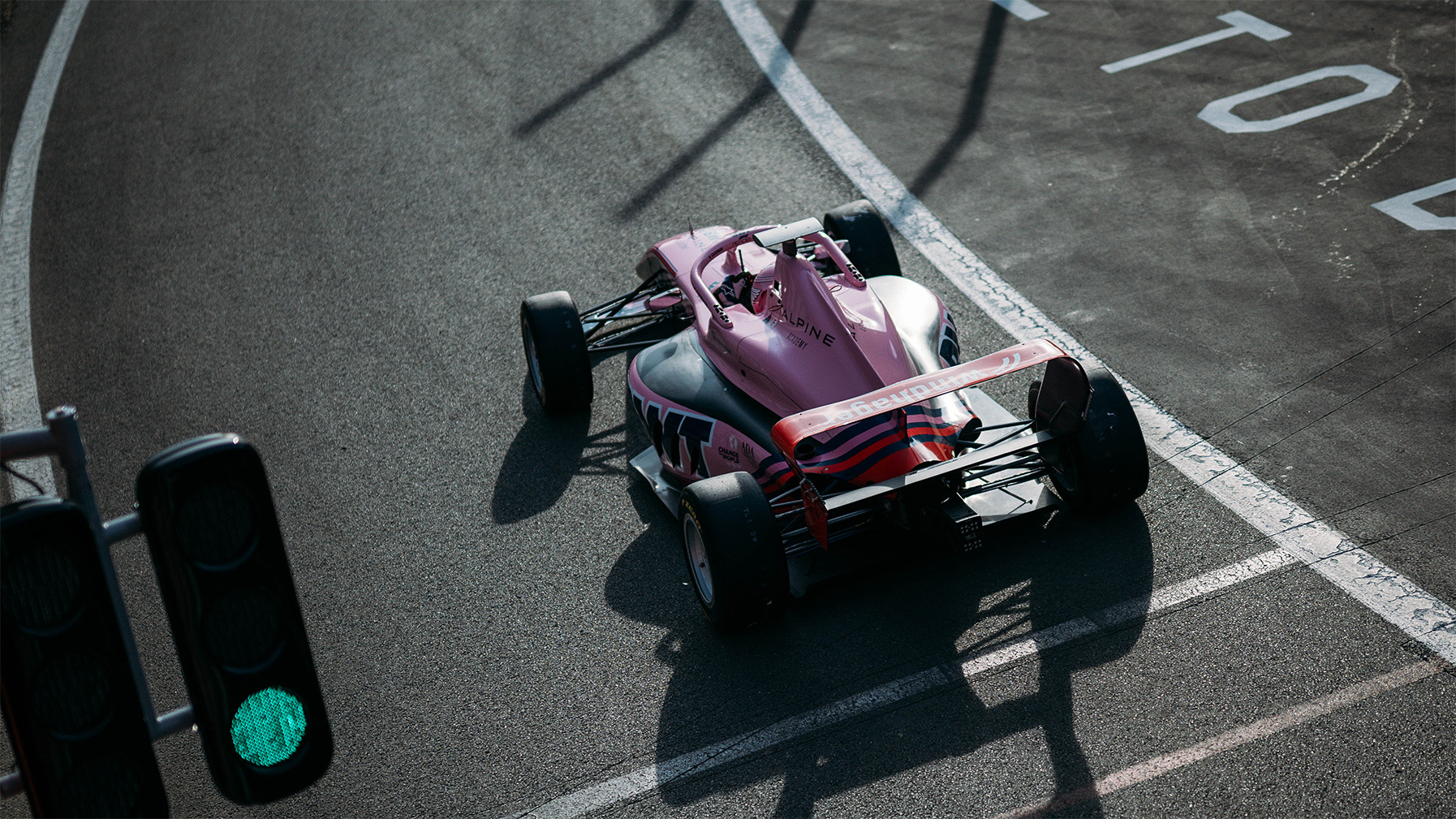
All that hard work opened the door to her big break – that single wildcard appearance at the 2024 F1 Academy weekend at Zandvoort. “Just the weekend before, during the British F4 round at Zandvoort, I’d done my best race to date, finishing 12th out of 27 drivers, just when F1 Academy came along to scout female drivers. For them, it was a no-brainer having a Dutch driver as a wildcard for the two Dutch races at Zandvoort! The most nerve-wracking part of the whole process was waiting to hear whether I’d been chosen. Once I found out, the tension lifted and it actually went very smoothly.”
With two fabulous performances on the famous circuit in the Dutch dunes, Gademan immediately made her mark on F1 Academy. She fully agrees that it was her breakthrough weekend. “Definitely, because up until that point my results hadn’t been anything to write home about. But that weekend I got the chance to show that I could do it – and in the very series where I saw my future. So you’re right, I certainly seized the opportunity, although I have to say that the wet track really helped me. Nobody had told me how a track transforms when Formula 1 cars have just been driving on it. It was 360 degrees different! So I still had a hard time in free practice. But then it rained during qualifying and all the extra grip had been washed away again – I was very lucky with that. In the races it was back to dry conditions, but by that time my engineer had explained to me very clearly what I needed to do. That’s how I finished fourth twice. I just missed out on the podium in the first race, but with those two fourth-place finishes, there were so many F1 teams wanting to sign me up for the 2025 F1 Academy season. After that weekend, I was certain of a seat for the following year.”
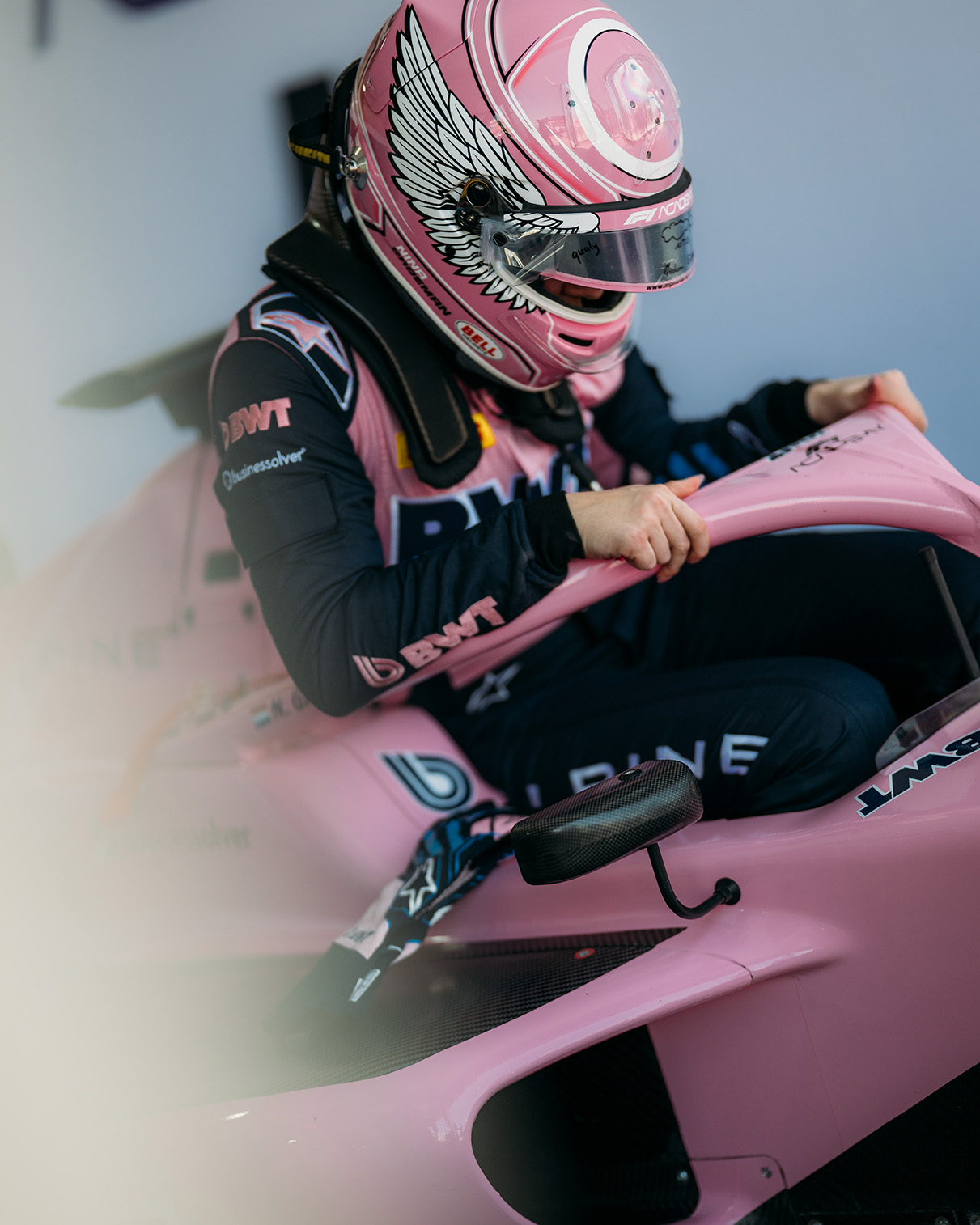
In her privileged position, she chose Alpine’s offer from among five – and for a clear reason: “F1 Academy is very much about media and visibility and everything that goes with it. But Alpine focuses heavily on my performance and mainly lets me do those hundreds of media engagements outside the race weekends. What’s more, I have a coach with me for every weekend who guides me very well. It’s true that my teammates Alba and Esmee enjoy doing things together as a group, but I’m more of a loner at the weekends. I don’t tend to wander around the whole paddock chatting to everyone either. For me, the race weekend is all about focus.”
In her first year, she was signed by Prema, this season she’s racing for MP Motorsport. Does she notice any differences? “Every team is different. No team is bad, but everyone has to be pulling in the same direction. That’s why, with Alpine, I made a conscious decision to switch to MP. This team gives it a 100 per cent. A bad weekend can happen, but it’s all about how you bounce back from it. At MP, I’ve noticed they have a really good approach to that. What’s more, Wouter Blokhuis is a great team boss; I can bother him with any kind of question. The fact that it’s a Dutch team is a nice bonus, but I just want to drive for a team that’s as eager to win as I am! Of course, it’s nice for them that they have a Dutch driver – two, in fact, with Esmee on board – but my engineer is Spanish and the working language is English.”
Gademan looks back on a successful first half of the season, highlighted by a victory in the opening race at Shanghai – and that’s despite the fact that she was still struggling with a niggling injury over the winter. “I had an operation at the start of this year, but during the tests leading up to the Shanghai weekend I still couldn’t move my hand properly. I simply couldn’t steer properly into Turn 7, so we only did a few runs. The race weekend wasn’t until a month later, so I’d had plenty of time to recover. But I’d barely been in the car at all! And then to go on and win the very first race straight away… I have to say: the comeback at Silverstone was actually even better. I’d made a small mistake in the second qualifying run, so afterwards we put our heads together: what do we need to change? Then, in the first race, we drove straight back onto the podium.”
Now her home meeting is just around the corner again. Does she feel that she has a home advantage? Given her stunning wildcard performance two years ago, you’d think so. “Ha, I honestly think there are girls who’ve done more laps at Zandvoort than I have! People believe that I know the track inside out just because I’m from the Netherlands. But I only raced there with Cor maybe four times, no more. I do think it’s a nice circuit, though. It’s got character, it’s different from other circuits.” So does a psychological home advantage perhaps play a part? “Not at all! Once that visor’s down, I couldn’t care less who’s sitting up there in the stands. I’m so focused, I don’t even see them. But once I’m out of the car, especially if I’ve done well, it’s brilliant to have loads of people around you straight away, cheering you on and asking for an autograph. What could be better than winning at home!”
Gademan is now in her second F1 Academy season, we begin to suggest – “I knew this question was coming!” she exclaims before the question has even been asked. “Coincidentally, from now on you’re allowed to race in F1 Academy for three years, but I’m not going to do that. I’m a bit older already and my goal is Formula 3. If I want to make it there, I’ve got to be moving up. Ideally, I’d like to race in one of the feeder series next year: FREC, Eurocup-3 or GB3. That means that after the summer I’ll be fighting hard for that second place in the championship, because then I will feel that I’ve really earned it.” And would she prefer to continue with MP? “Yes, I think so. I tested a Eurocup-3 car on one occasion last year and really liked it. They do have a new car this year, but I’m sure I’ll love that one too. The downside of the F4 cars in F1 Academy is that they don’t have adjustable front camber. That makes the car feel a bit numb. I’d really love to have a car where you can get a bit more feel for it.”
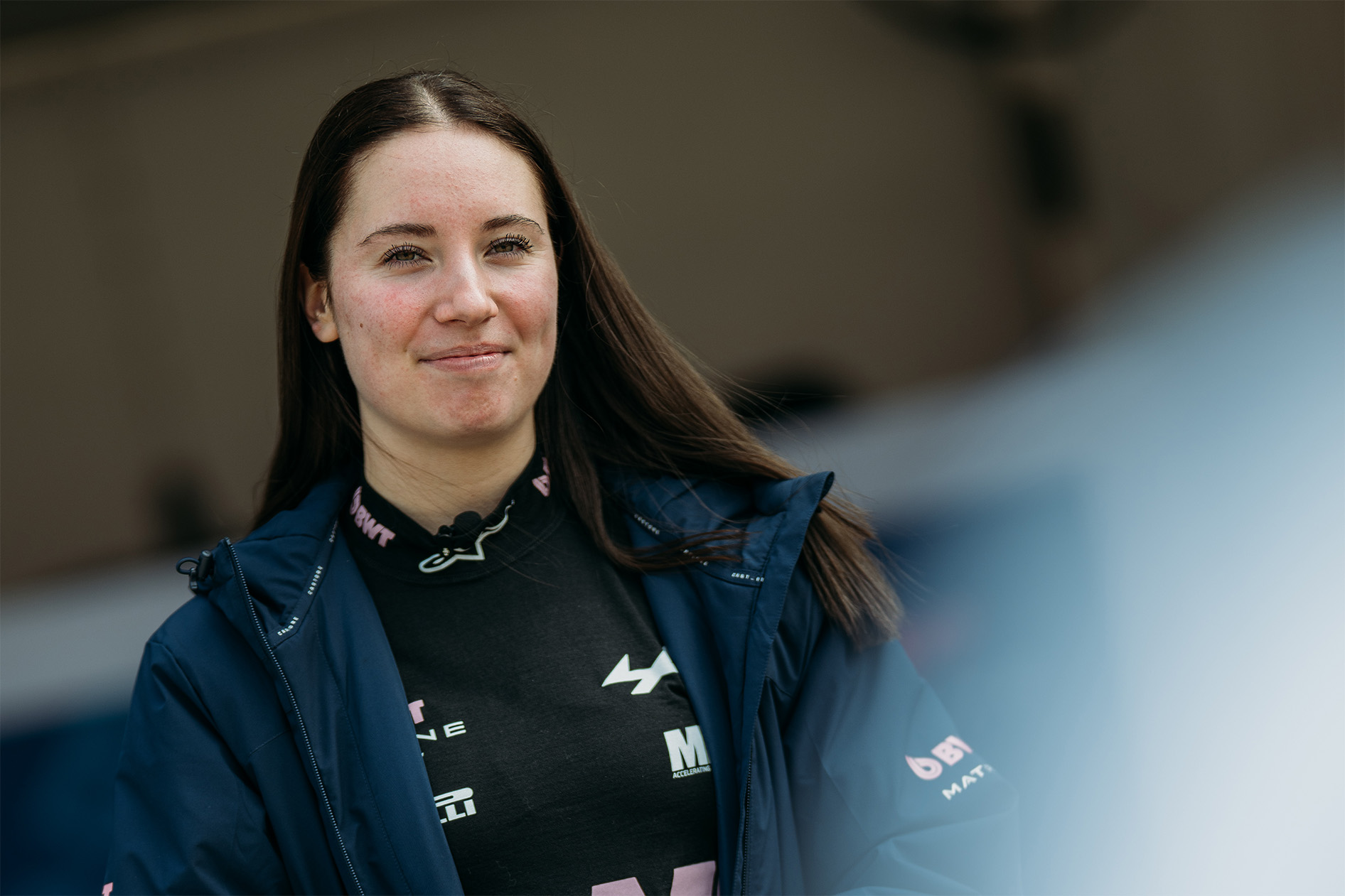
She acknowledges that for most of the top F1 Academy drivers a future in sportscars lies ahead – we need only look at Jamie Chadwick and Doriane Pin. Does she ultimately see that as her future as well? “Formula 3 is my goal. But I’m open to moving on to LMP2 afterwards, just like Richard Verschoor did, or doing LMP3 first. Or the Porsche Supercup – that would be brilliant too.” Still, she is determined to reach a higher level in single-seater racing first before making that horizontal move to the sportscar column, she states firmly. “First, I want to achieve my own goal and then I will look further ahead. It would be an honour to achieve my goal with MP, because it’s a top team in both FREC and Eurocup-3. But that also makes it an extremely popular team – everyone wants to drive for MP! It would be great, but a lot can still happen. There’s still a long way to go this year.”


