
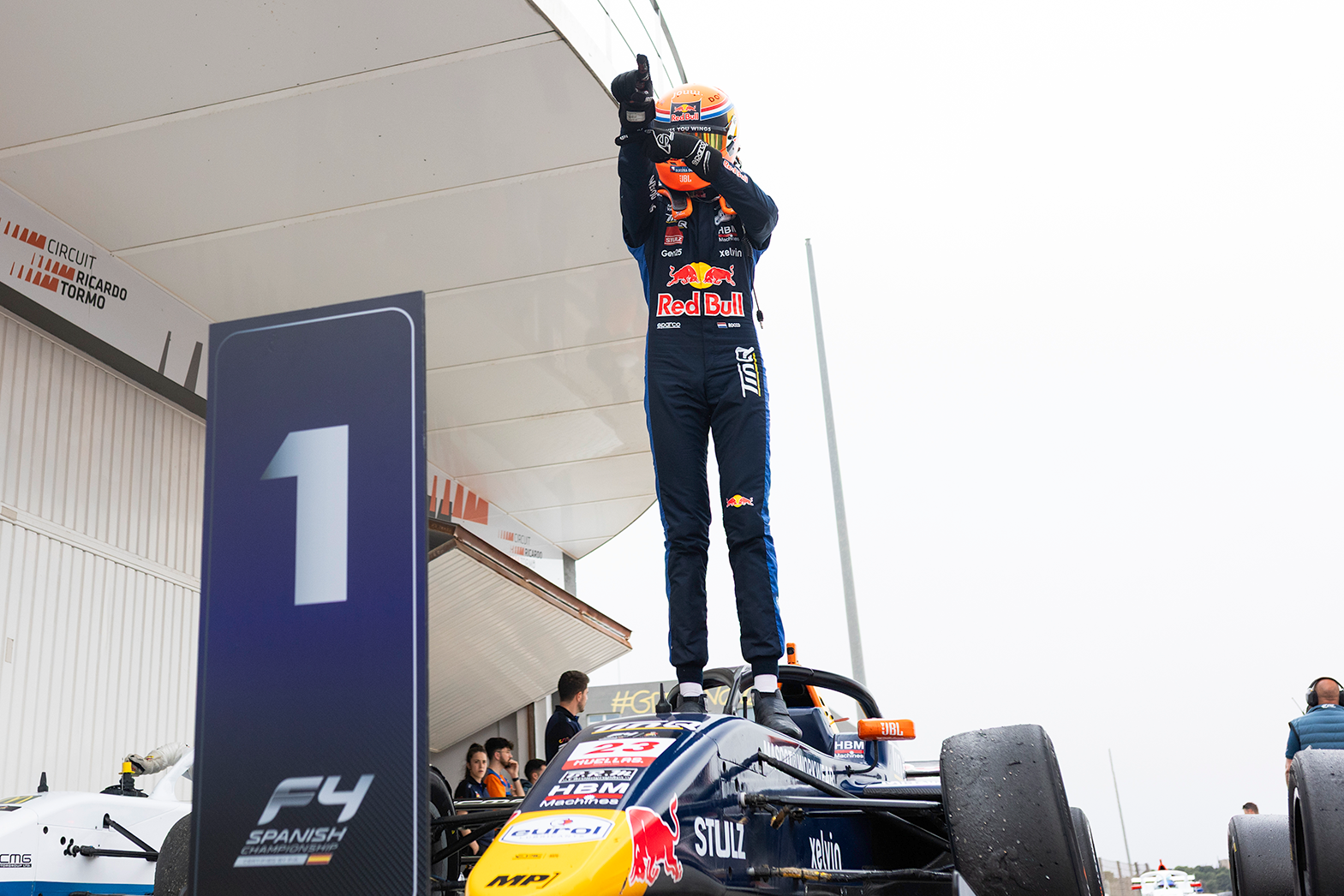
The F4 Spanish Championship has grown in strength over recent seasons to become arguably the most competitive F4 category in the world today. Proof of this was provided in the three weekends of the Spanish Winter Championship, which regularly saw the top 20 drivers qualify within a second of pole. As one of the leading contenders, Rocco Coronel managed to hold his own among this strong entry. Now, the Red Bull junior at MP Motorsport is aiming for top honours in the main Spanish championship as well – as he subsequently proved during a highly successful opening weekend at Valencia. We caught up with the 15-year-old from the Dutch village of Eemnes to discuss his progress, the F4 car compared to other cars, and his expectations for the coming season.
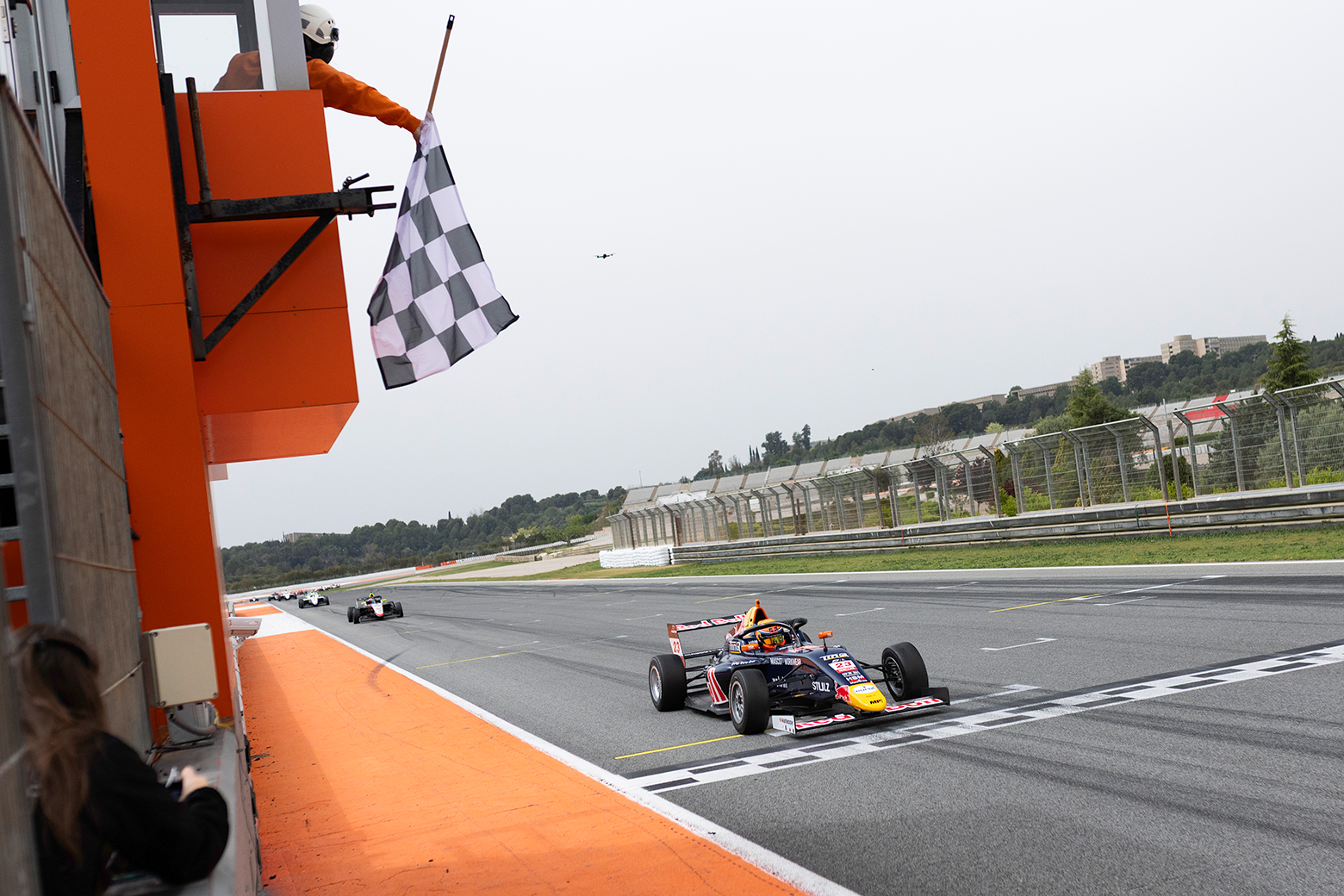
We now know that the opening weekend at the Ricardo Tormo circuit in Valencia yielded two overall victories for the Dutch rookie, but we meet the young Coronel on the eve of the F4 Spanish Championship. He is still to travel to Spain, as he spends the Easter weekend preparing in the Netherlands, at Zandvoort, where he is due to compete in the local Easter Races. Rocco’s father Tom will drive an older-model Mazda MX-5 in the MaX5 Racing Cup, whilst Rocco himself will take part in the Westfield Cup. We are reaching the end of Good Friday when the youngster is still busy testing. On our approach in the pit lane to inform when he thinks he is finished, he looks up at the dark grey sky and we see a twinkle in his eye. “Another 20, 30 minutes!” We can’t possibly disagree with his reply. The drizzle that’s been falling all afternoon has turned the circuit into a slippery fun machine. In the MDM garage, Coronel senior nods approvingly. “Good, he clearly doesn’t need any encouragement!”
A little later, we settle into the Coronels’ camper van, their home for the entire weekend. The next day, Tom will be celebrating his 54th birthday at the circuit – true racers! Three weeks have passed since the end of the Spanish Winter Championship, and after the weekend at Valencia there’s another gap of almost two months. So what does he get up to in the meantime, is our first question to Rocco Coronel. “Work out, and sit in the sim. And school, of course. I had a lot of catching up to do for school, but I’m getting on with that now. If all goes well, my exams will fall right in that gap after Valencia. We have had the official test at Barcelona, but after Valencia you’re not really allowed to do anything for over a month and a half. So you have to come up with other stuff, like these Easter races. I’ve driven three cars today – my dad’s Mazda, the Westfield and one of MDM’s BMWs. There’s a ten-second gap in lap times between them, so we’re seeing how quickly I can switch between those cars. Because it’s wet now, you need to be able to find good lines. You learn from that too. It was my first time driving the Westfield, but within three laps I was matching the times of those at the front.” Just how quickly he really got to grips with the car became clear later in the weekend when he won all three Westfield races.
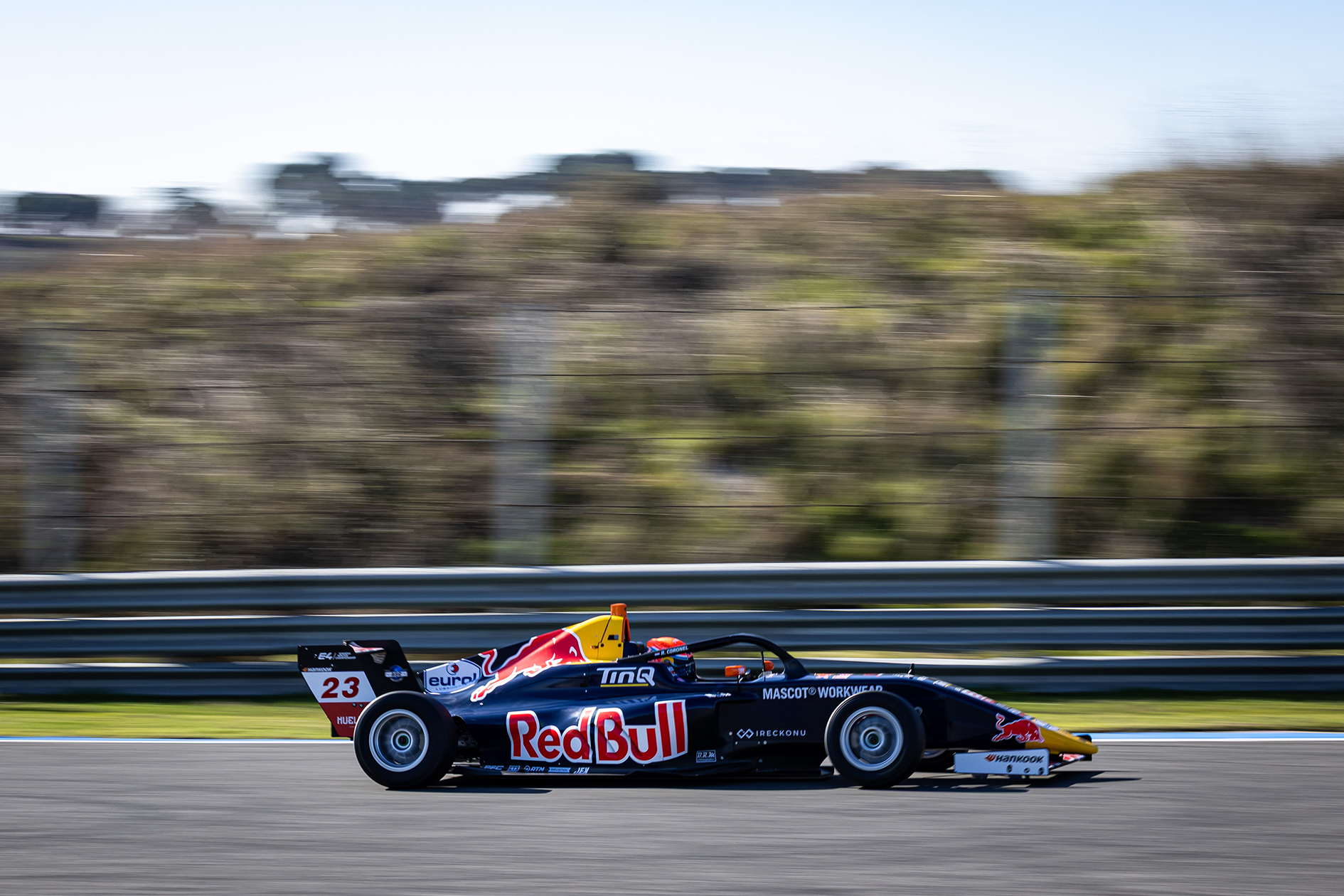
This winter, Coronel took on not one but two winter championships. For MP, for whom he is running his main programme in Spanish F4 this year, he took part in the Spanish Winter Championship, a winter championship run by the same organiser as the Eurocup-3 and the Spanish F4 Championship. Prior to that, he spent a couple of weekends racing with the other Dutch team of VAR in the Formula Winter Series, where the best teams from Italian and British Formula 4 join up for their winter preparation. At Estoril, in the rain, he managed to beat eventual champion Dries Van Langendonck to secure his first F4 victory. How does he view his overall progress across both championships? “At the start we were around seventh or eighth fastest, but we were soon battling for top-three positions. In the meantime, we’ve tried quite a few things with the car and I’ve also got a better feel for it myself. Otherwise, I think it was a great little winter season. Apart from the weekend at Jarama, where I kept retiring through no fault of my own. The speed is there, now it’s just a matter of being smart,” is how he sums up his winter months.
In the Formula Winter Series, he drove on the Pirellis they also use in Italy and the UK, while in the Spanish Winter Championship, the teams use the same Hankooks as in the regular Spanish championship. “It’s not a massive switch between Pirelli and Hankook. One tyre manufacturer does things just a little differently from the other, but it’s still just rubber. On the Pirellis you have to brake a bit harder to stop, but it’s pretty much the same. The cars are the same too, of course: it’s all Formula 4. In both championships, you saw that the top seven or eight cars were evenly matched, but in the Spanish championship you had to fight harder. That was also down to the fact that we only drove on dry tracks there. In the Formula Winter Series, we also had wet weekends, and because of that, the field was a bit more spread out at times.”
.png)
Now that he is driving so many more cars than just the Tatuus from Formula 4, is he able to draw any comparisons? “Formula 4 is the foundation of motorsport,” he says, setting the tone upfront. “It’s the first step you take, and you can’t take any other step, because you’re only allowed to start in higher categories from the age of 16. You can play around with the aero a bit, but it doesn’t have that much of an effect because there isn’t much of it. You can, however, do a lot with the shock absorbers, the ride height, and the anti-roll bar, which you can tighten or soften up. Those are the things you can change in the set-up to make the car go faster. It’s a completely different way of driving compared to a kart. In a kart, you have to keep your steering wheel as straight as possible while making the rear end slide. You shouldn’t do that in the single-seater. There, the rear is very stable and you must never let it slide, so it’s all about getting the front right. Yes, that’s true, it’s almost the opposite driving style. That’s why some drivers who did well in karts initially struggle in single-seaters. But because they’re so talented, they catch up later on.”
And how does he compare the GP3 car he once tested at a Red Bull selection day? Does that extra power and downforce make a difference to the balance? “Phew, that was really too long ago – I was 13 back then! But no, it still doesn’t. In karting, you shouldn’t keep the rear on the ground, because that’s what you turn with. In single-seaters, you turn in with the front. So if the rear goes, you just slide off carrying all that weight. That’s why so many people spin. And when they do, they spin completely. So with every step you take, you move further away from the karting style. In fact, I think F4 is closer to karting than F3, F2 and F1.”
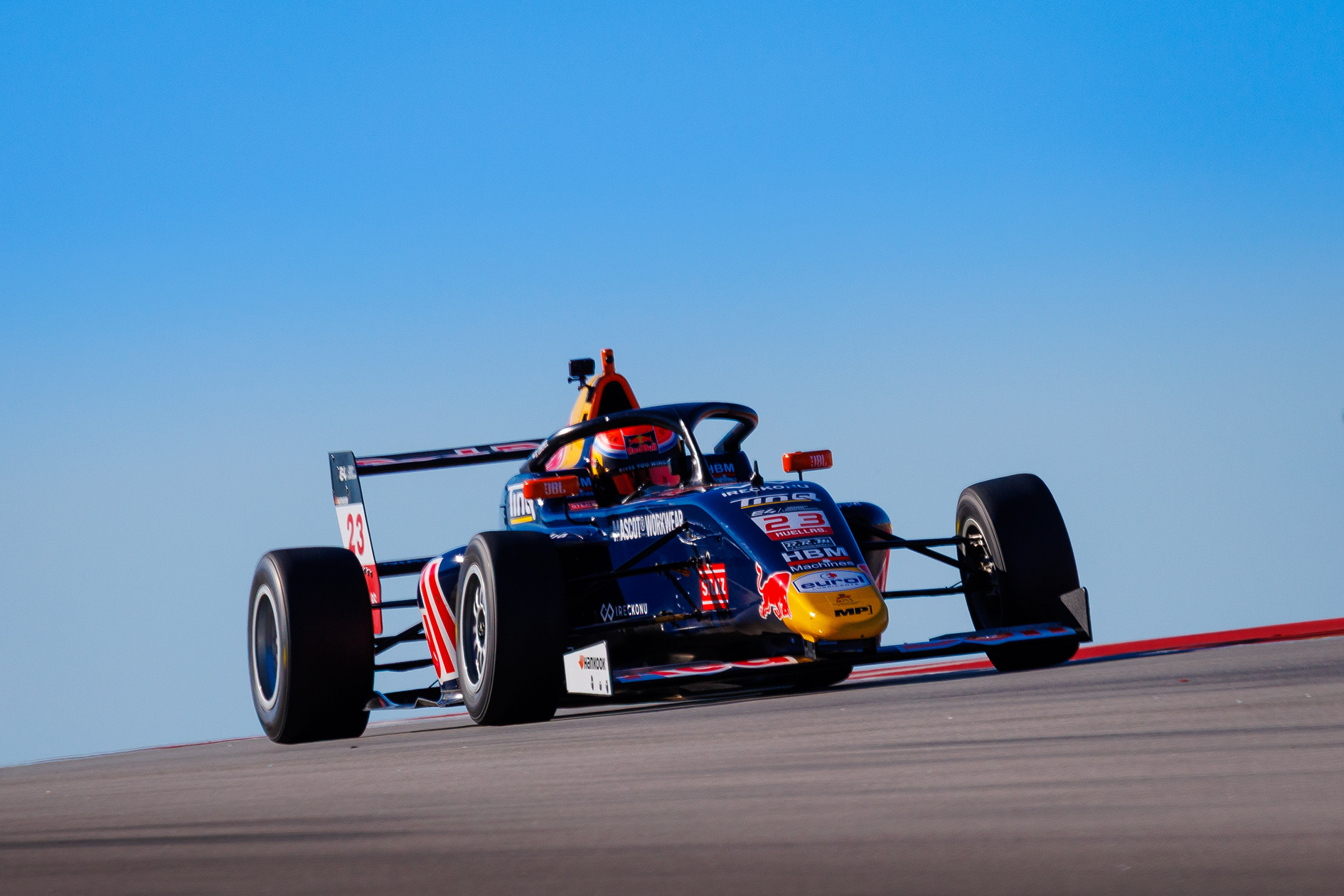
Last year, at the age of 14, Coronel became Ginetta Junior Cup champion. Where does the Ginetta G40J fit in between karts and an F4? “The Ginetta is very similar to a kart: you also oversteer into the corner. You wait for the understeer to come and then turn with the rear. But you also brake late, just like you do in single-seaters. And you need good exits, because you don’t have much power in those Ginettas – that’s similar to karting again. It’s actually a stepping stone somewhere in the middle, which is why we did it.” In the same breath, he also looks at the Westfield he’s just been introduced to: “With the Westfield, it’s also about watching out for the understeer to come and then putting everything on the rear. The power-to-weight ratio in a car like that is also quite low: 190 hp, but it weighs just 580 kg, so it’s seriously quick. And you’re completely exposed, so in that respect too it’s similar to a kart.”
Coronel now faces the task of giving his all in the Spanish F4 Championship. In the winter championship, second-year drivers finished ahead of him in the final standings, but the young Dutchman still managed to reach the podium four times. He also already set the fastest lap of the race once. When should his more experienced rivals start watching their backs? His response is more cautious than what he might have said a good week and two F4 victories later: “You can’t be fast straight away in the very first race. That takes time. But somewhere in the middle of the season, we rookies will get the hang of it. And then we’ll do well.” The words that follow, however, are all the more relevant given his current lead in the overall standings: “So I’m not looking at the rookie championship, but simply at the overall standings. That’s what it’s all about, isn’t it? In Formula 1, you don’t have a rookie champion either. You just want to become the overall champion!”
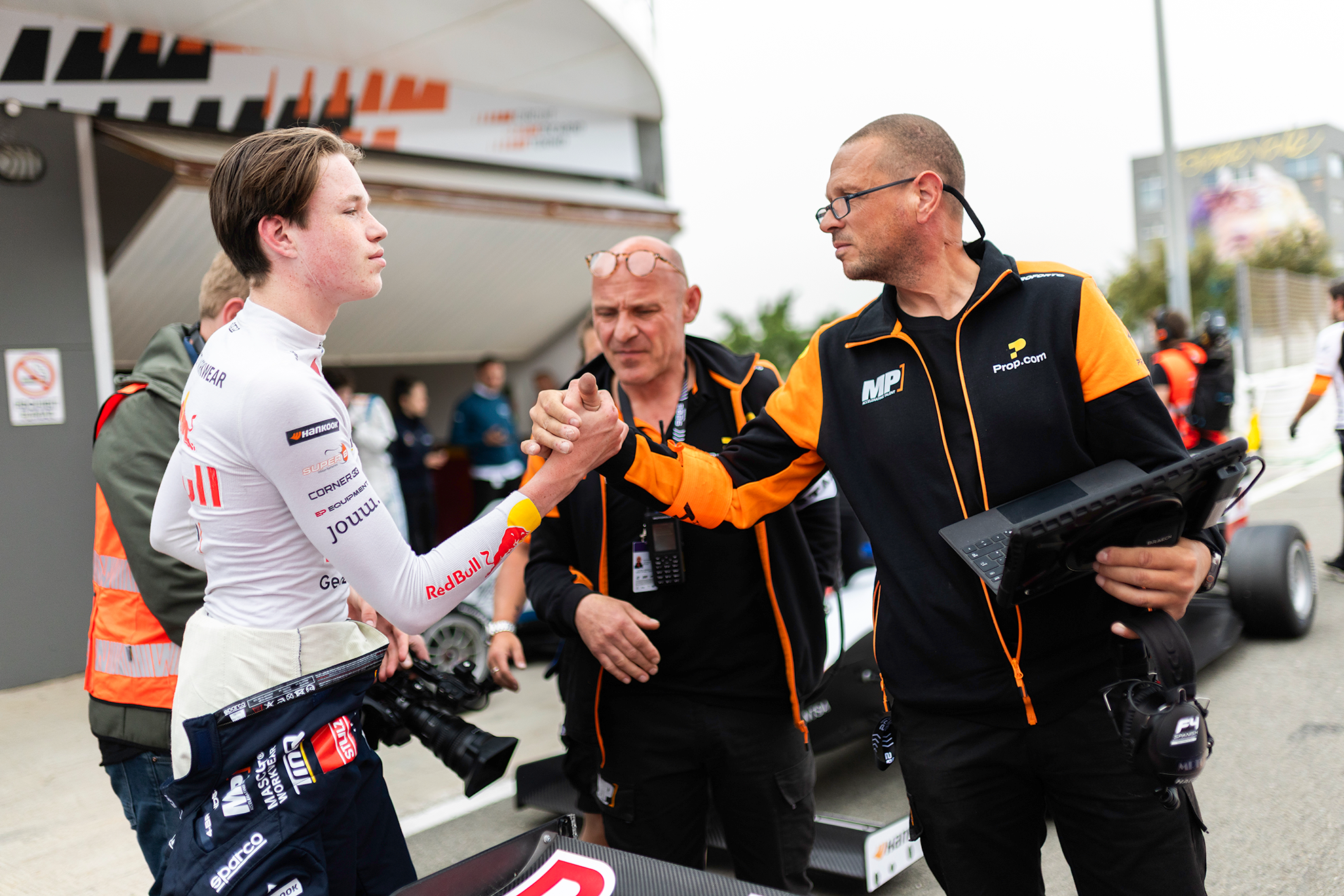
What steps do he and the team need to take to achieve that? “Everything has to be spot on. Anyone can make mistakes, so you really have to stay focused. With an entry like this, it’s almost impossible to win every race, especially not with second- and third-year drivers around who have all done it before. We’re all still figuring it out. I can prepare on the sim, but you can’t compare that to real track experience. In real life, it’s always different. For me, the sim is more about track reconnaissance. What you sometimes see is that you go full throttle into a corner and then just about manage it in the sim. But try that in real life, and I’m 100% sure you’ll end up off track! Thanks to the sim, you know the length of a straight and roughly where you need to brake and turn in. But you need to combine that with looking at data and watching videos. To me, the latter is particularly useful, because that’s where I can see what actually happened, what was actually done. The team is able to help me with that. I have a good engineer, who I get on well with. That’s why we chose to go with MP.”
MP Motorsport is heading into the coming season with six rookies, now that Reno Francot is moving up to Formula Regional after three seasons in F4. Replacing Coronel’s fellow Dutchman is Canadian Jensen Burnett, who has joined the team late. Coronel sees it as an inevitable cycle. “Two years ago, almost everyone in the team was a rookie too, so it just depends on the season. We have to figure things out for ourselves a bit now. In that respect, Reno has certainly been a great help to me in the winter championship: you see how calm he remains behind the wheel and how cleverly he positions himself during the races. That’s where you see the difference between a rookie and drivers who have been doing this for a few years. They take just a little less risk, whereas a rookie will always go all out. If you’re going for the championship, you have to be willing to finish second. So don’t put everything at stake and risk losing every possible point. Then you’re not racing for the championship, but just for yourself.”
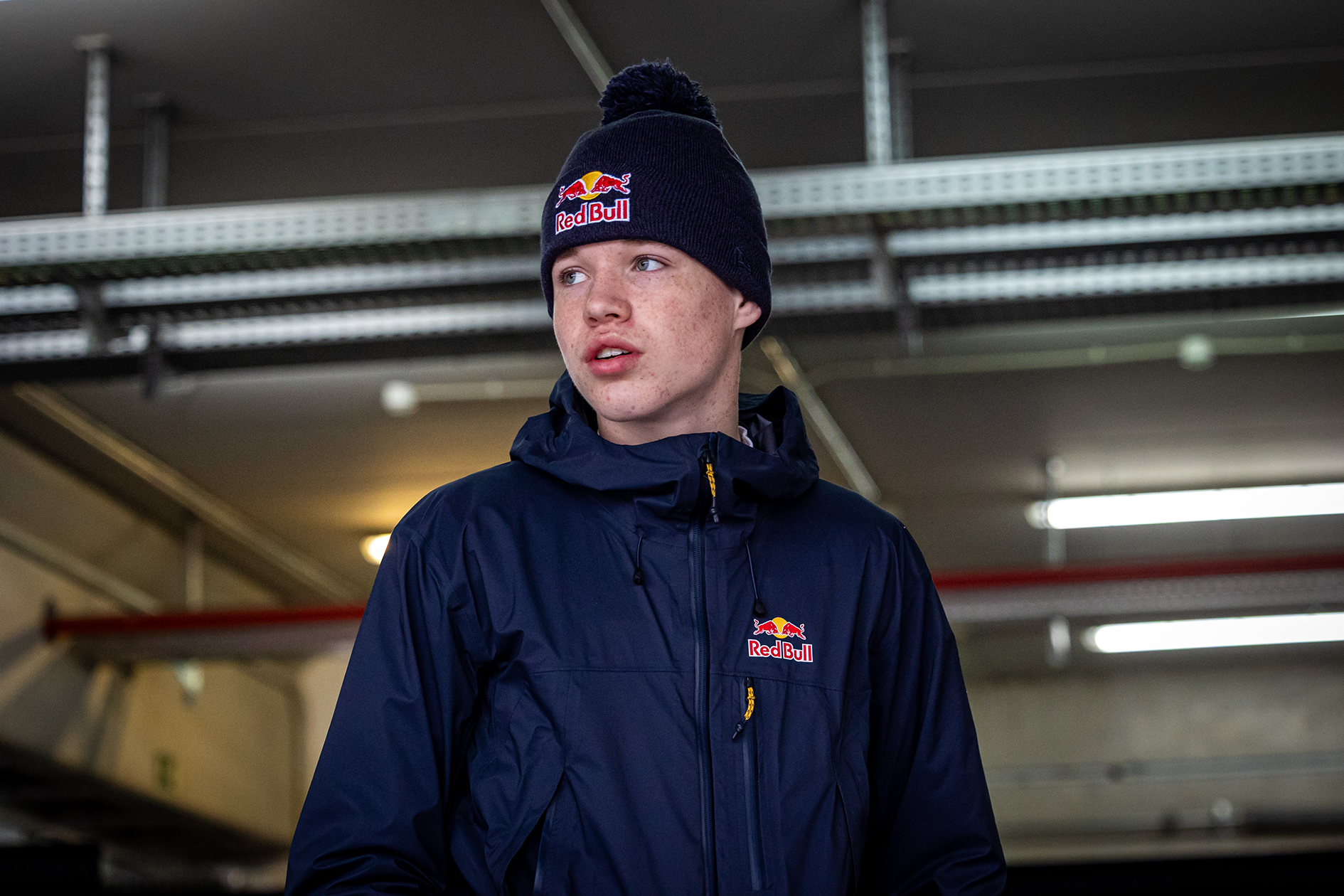
Does he have any expectations for the coming season? “Red Bull has expectations!” he says with a laugh. “But I don’t worry about that. I just do my best. If the car can’t go any faster, then the car can’t go any faster. If I can’t go any faster, I can’t go any faster. I’m quite happy with what I’m doing now. And apart from that, I mustn’t get frustrated. That’s just a waste of time. Like at Jarama, where I had the pace but went off through no fault of my own. It bothered me at first, but I’ve learnt from that. I didn’t get the results, but I had the pace. I had to experience that once, but next time I’ll get over it more easily. This year, I just want to get the most out of every race.”


